
Imagine walking home along a quiet road in Japan.
It’s late, the streets are nearly deserted, and the only light comes from a few lanterns glowing outside the houses. You’re tired, and all you want to do is get home.
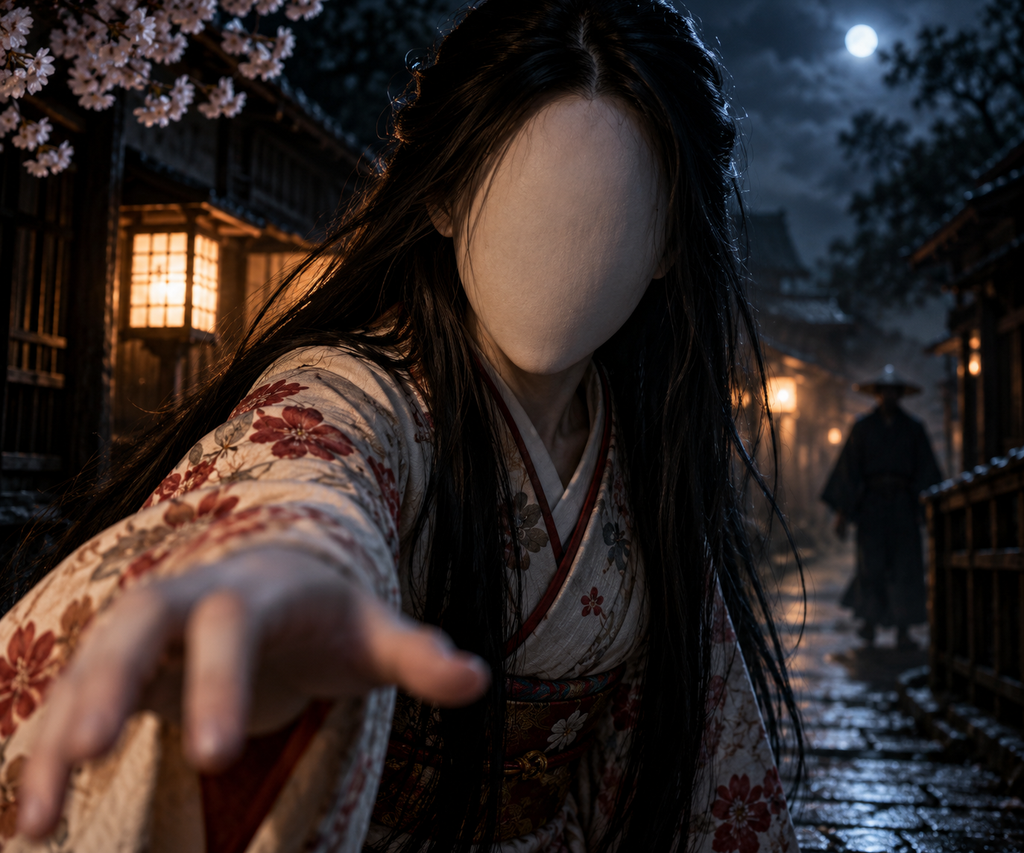
Then you notice a woman standing beside the road.
She’s dressed in a beautiful kimono, with long black hair falling down her back. Her shoulders are trembling, and you can hear her crying softly.
You hesitate. Something about finding a woman alone at this hour makes you uneasy, but you can’t simply leave her there.
You approach and ask if she’s all right.
She doesn’t answer.
Instead, she slowly raises her head.
At first, you can’t understand what you’re seeing. Her hair is normal. Even the shape of her head looks perfectly ordinary.
But where her face should be…
There’s nothing.
No eyes. No nose. No mouth.
Just smooth, empty skin.
You stumble backward, your heart pounding, as the woman turns fully toward you.
And somehow, even without eyes, you know she’s looking directly at you.
You run.
You don’t stop until you find a small shop with a light burning inside. The shopkeeper listens as you breathlessly explain what happened.
Then he raises his hand to his face.
“You mean… like this?”
And before your eyes, his features disappear.
Welcome to the terrifying Japanese legend of Noppera-bō, the Faceless Ghost.
What Is Noppera-bō, the Faceless Ghost?
In Japanese folklore, Noppera-bō is a mysterious supernatural being known for appearing human while possessing a completely featureless face.
At first glance, there’s nothing unusual about it.
It might look like a woman walking along a lonely road, a traveler resting beneath a tree, or even someone you know.
Its clothing is ordinary, its movements are natural, and it behaves just like any other person.
Until you get close enough to see its face.
Its eyes, nose, and mouth vanish, leaving nothing but smooth, blank skin.
Unlike many supernatural creatures, Noppera-bō isn’t usually described as attacking people or dragging them away. Instead, it seems to delight in frightening them.
And it has a particularly cruel way of doing it.
It waits until someone feels comfortable, concerned, or curious enough to approach.
Then it reveals what lies beneath its human appearance.
Or rather, what doesn’t lie beneath it.
What Does Noppera-bō Look Like?
One of the most frightening things about Noppera-bō is that there’s no reliable way to recognize one before it reveals itself.
Unlike towering monsters or grotesque spirits, Noppera-bō doesn’t necessarily have claws, fangs, glowing eyes, or an unnatural body.
In fact, it often looks entirely ordinary.
Traditional stories describe encounters with women, strangers, and familiar-looking figures whose faces suddenly become smooth and featureless.
Some appear dressed in beautiful clothing. Others resemble everyday travelers or townspeople.
But when the moment comes, their faces become blank surfaces.
No eyebrows. No eyelids. No lips.
Not even a nose.
And here’s something that makes the legend even more unsettling.
Noppera-bō doesn’t always reveal its true appearance immediately.
Sometimes it waits until you’ve spoken to it. Sometimes it lets you approach close enough to see every detail of its clothing.
And sometimes, according to the stories, it waits until you’ve escaped one terrifying encounter before revealing itself again.
Because seeing one faceless ghost is frightening enough.
Seeing two in the same night might make you question whether anyone around you is real.
The Famous Noppera-bō Legend of the Mujina
One of the best-known stories involving a faceless apparition was popularized by writer Lafcadio Hearn in his 1904 collection Kwaidan: Stories and Studies of Strange Things.
The tale is called “Mujina.”
Although the story uses the name mujina, the apparition behaves like the creature now widely recognized as Noppera-bō.
And it remains one of Japan’s creepiest traditional ghost stories.
The story begins on a lonely road in Tokyo, near a place known as the Akasaka slope.
Long ago, the road was bordered by a deep ditch, and travelers sometimes passed through the area after dark.
One night, a man was walking along the road when he noticed a woman crouching beside the ditch.
She appeared to be crying.
Concerned that she might be thinking of throwing herself into the water, he approached her and asked what was wrong.
The woman didn’t answer.
He tried again, but she continued crying.
Finally, she turned toward him.
And the man saw something that sent him running for his life.
The woman had no eyes, no nose, and no mouth.
Her face was completely smooth.
Terrified, he fled down the road until he spotted a light in the distance.
It came from a small stall belonging to a soba seller.
The man rushed toward it, desperate to find another human being.
The seller listened as the frightened traveler tried to explain what he’d seen.
A woman. A terrible face. Something impossible.
Then the seller asked a simple question.
“Was it anything like this?”
He passed his hand over his own face.
And suddenly, his eyes, nose, and mouth were gone.
The man had escaped one faceless apparition only to encounter another.
And that’s where the story ends.
No comforting explanation. No revelation that it had all been a misunderstanding.
Just a terrified traveler discovering that the creature he’d fled from might not have been alone.
Why Does Noppera-bō Hide Its Face?
Now, here’s something interesting about this particular spirit.
Many Japanese supernatural creatures have recognizable motives.
Some seek revenge, others guard certain places, and still others punish people who break a rule or wander somewhere they shouldn’t.
But Noppera-bō seems to have a different purpose.
It wants to frighten you.
In many traditional stories, the creature doesn’t physically harm its victim. It simply reveals its blank face and watches the person panic.
Sometimes the encounter ends there.
Other times, the victim escapes only to meet another faceless figure.
But why?
Perhaps the creature enjoys watching humans react to something they cannot understand.
Perhaps it’s playing a cruel joke.
Or perhaps there’s something more sinister about a spirit that can steal the appearance of an ordinary person.
After all, think about what a face means.
It’s how we recognize people and understand their expressions. A familiar face can make us feel safe.
But Noppera-bō takes all of that away.
It looks human until the very thing that makes it recognizable disappears.
And once you’ve seen it happen, how can you ever be certain the next person you meet isn’t hiding the same terrible secret?
Is Noppera-bō a Ghost or a Yokai?
Although Noppera-bō is often called the Faceless Ghost, it belongs to the broader world of Japanese yōkai.
Yōkai are supernatural beings found throughout Japanese folklore. They include mysterious spirits, strange creatures, shapeshifters, and entities that don’t fit neatly into ordinary categories.
Some are frightening, some are mischievous, and others are dangerous.
Noppera-bō is usually associated with the mischievous side of this supernatural world.
But don’t let that description fool you.
There’s nothing particularly funny about encountering a person whose face suddenly disappears.
Especially when you’re alone.
In Japanese folklore, certain shapeshifting animals, particularly foxes and tanuki, were also believed capable of deceiving humans by taking different forms.
The term mujina has been used for animals such as badgers, depending on the region, and appears in stories involving supernatural transformations.
This helps explain why the famous faceless apparition in Hearn’s story is called a Mujina.
But whatever name is used, the frightening image remains the same.
A human figure turns toward you and reveals a face that isn’t there.
Where Does the Legend of Noppera-bō Come From?
Stories of faceless supernatural beings have circulated in Japan for centuries.
Noppera-bō appears in traditional folklore and accounts associated with the Edo period, when stories about strange encounters, ghosts, and yōkai were widely shared.
During this era, supernatural tales became popular entertainment. People gathered to exchange frightening stories, and artists created illustrations of the mysterious creatures said to inhabit the world around them.
Japan’s folklore was filled with unusual beings.
Women with impossibly long necks.
Spirits that appeared in mirrors.
Creatures lurking near rivers, roads, and abandoned buildings.
And among them was the faceless figure known as Noppera-bō.
Unlike a ghost tied to one particular house or cemetery, Noppera-bō could appear almost anywhere.
A lonely road. A quiet village. A deserted path after sunset.
The setting didn’t have to be haunted.
It only had to be somewhere a person might find themselves alone with a stranger.
And perhaps that’s why the legend has remained so unsettling.
Nearly everyone has experienced that uncomfortable moment when they encounter someone unexpectedly in an isolated place.
You glance toward them.
They turn to look at you.
And for one terrible second, you wonder what you’ll see.
The Terrifying Trick of the Second Faceless Ghost
Of all the details associated with Noppera-bō, I think this one is the most disturbing.
Sometimes the first encounter is only the beginning.
In the famous Mujina story, the traveler believes he’s escaped the supernatural woman.
He runs until he finds another person.
A shopkeeper. Someone ordinary. Someone who should be able to help.
And then that person reveals the same featureless face.
It’s a simple trick, but it’s incredibly effective.
Because the victim’s sense of safety disappears twice.
The first encounter makes him afraid of the creature.
The second makes him afraid of everyone.
Imagine escaping something impossible and finally finding a house with its lights on.
You knock on the door.
A kindly old woman answers.
You tell her what happened.
She listens patiently, then asks you to describe the face.
You tell her there wasn’t one.
She tilts her head.
“You mean like mine?”
And suddenly, you’re staring at another smooth, empty face.
Where do you run now?
And more importantly…
How do you know the next person won’t be the same?
Does Noppera-bō Ever Attack People?
Unlike many terrifying creatures found in folklore, Noppera-bō isn’t generally known for physically attacking its victims.
Its preferred weapon seems to be fear.
It appears, reveals its face, and leaves the unfortunate witness to deal with what they’ve seen.
That might sound harmless compared to legends involving creatures that hunt or kill.
But imagine the effect of such an encounter.
You see something that should be impossible.
You run for help.
Then the person you turn to for comfort reveals the same terrible secret.
Even if you escape unharmed, would you ever feel completely safe around strangers again?
Would you look twice at someone standing alone on a dark road?
Would you hesitate before approaching a crying woman?
And what if you noticed someone watching you from the other side of the street?
Someone standing perfectly still.
Someone whose face you couldn’t quite make out.
Would you wait for them to turn around?
Or would you keep walking?
Similar Legends: Other Terrifying Spirits and Shapeshifters
Noppera-bō isn’t the only supernatural being that hides its true nature. Across the world, legends warn of mysterious figures that appear ordinary until something horrifying reveals what they really are.
The Eight-Foot-Tall Woman
Known in Japan as Hachishakusama, this terrifying figure is said to appear as an unnaturally tall woman, often dressed in white and wearing a wide-brimmed hat.
According to legend, once she chooses someone, escaping her attention may be nearly impossible.
Kuchisake-onna: The Slit-Mouthed Woman
Another famous Japanese urban legend tells of a woman wearing a surgical mask who approaches strangers and asks whether they think she’s beautiful.
But when she removes the mask, she reveals a horribly disfigured mouth.
There may be no safe answer to her question.
The Tlahuelpuchi
In Mexican folklore, the Tlahuelpuchi is a supernatural shapeshifter said to live among ordinary people.
By day, the creature may appear completely human. But after dark, it transforms into something far more frightening.
Like Noppera-bō, its ordinary appearance can conceal a terrifying secret.
The Black-Eyed Children
Modern urban legends tell of mysterious children who appear at doors or car windows, asking to be let inside.
At first, they may seem like ordinary children in need of help.
Then someone notices their eyes.
Completely black.
And suddenly, the request to come inside doesn’t seem so innocent.
Final Thoughts: What If the Next Face You See Isn’t There?
There’s something especially disturbing about Noppera-bō.
It doesn’t need a haunted castle, an ancient curse, or a dark forest.
It only needs you to trust what you’re seeing.
A crying woman beside the road.
A friendly shopkeeper offering help.
A familiar stranger standing beneath a streetlight.
Everything seems perfectly normal.
Until it isn’t.
Perhaps that’s why the old story of the Mujina remains so effective.
The traveler escapes one faceless figure, only to discover another waiting where he least expects it.
And once you’ve heard that story, it’s hard not to imagine the same thing happening to you.
Picture yourself walking home late one evening.
The street is quiet, and most of the houses are dark.
Ahead, a woman stands beneath a flickering streetlight.
Her back is toward you.
You notice her shoulders shaking.
She’s crying.
You hesitate, then ask if she needs help.
Slowly, she turns.
Her face is completely blank.
You run until you reach a small convenience store.
The man behind the counter looks up as you stumble inside.
You tell him what happened.
He listens without interrupting.
Then he leans forward.
“You mean she had no face?”
You nod.
The man smiles.
Or at least, you think he does.
Because as you watch, his eyes disappear.
Then his nose.
Then his mouth.
And suddenly, you’re staring at another smooth, featureless face.
Only this time, there’s nowhere left to run.
Frequently Asked Questions About Noppera-bō
What is Noppera-bō?
Noppera-bō is a supernatural being from Japanese folklore known for appearing human before revealing a completely featureless face. It is commonly described as a faceless ghost or yōkai.
What does Noppera-bō mean?
The name Noppera-bō is associated with a smooth, flat, or featureless appearance, referring to the creature’s lack of facial features.
Is Noppera-bō dangerous?
In most traditional stories, Noppera-bō frightens people rather than physically attacking them. However, its sudden transformation and ability to appear ordinary make it one of Japan’s most unsettling supernatural figures.
What is the difference between Noppera-bō and Mujina?
The terms are connected through Japanese folklore, particularly the famous story Mujina by Lafcadio Hearn. The story’s faceless apparition is commonly identified with Noppera-bō, while mujina is also a traditional term used for certain animals associated with shapeshifting tales.
Is Noppera-bō a ghost or a demon?
Noppera-bō is generally classified as a yōkai, a broad category of supernatural beings in Japanese folklore. Although frequently called a faceless ghost, it isn’t necessarily the spirit of a deceased human.
About the Author
Karen Cody is the creator of Urban Legends, Mystery, and Myth, a blog exploring eerie folklore, strange history, and the mysteries behind the world’s most chilling stories. From haunted places and supernatural creatures to ghost stories, horror films, and modern myths, she examines the legends—both ancient and modern—that continue to fascinate and frighten us.
© 2026 Karen Cody. All rights reserved.